
Coffee Packaging Trends: How Brands Choose Better Packaging Solutions
The global coffee industry is undergoing a period of intense innovation. Driven by the growth of specialty roasters, direct-to-consumer (DTC) subscription models, and evolving international environmental standards, coffee packaging plays a pivotal role in maintaining product freshness, preserving volatile aromatic compounds, and standing out on crowded retail shelves.
For roasters, CPG brand owners, and coffee procurement directors, selecting the right packaging format involves balancing roast degassing requirements, barrier engineering, sustainability compliance, and high-speed filling machinery runnability.
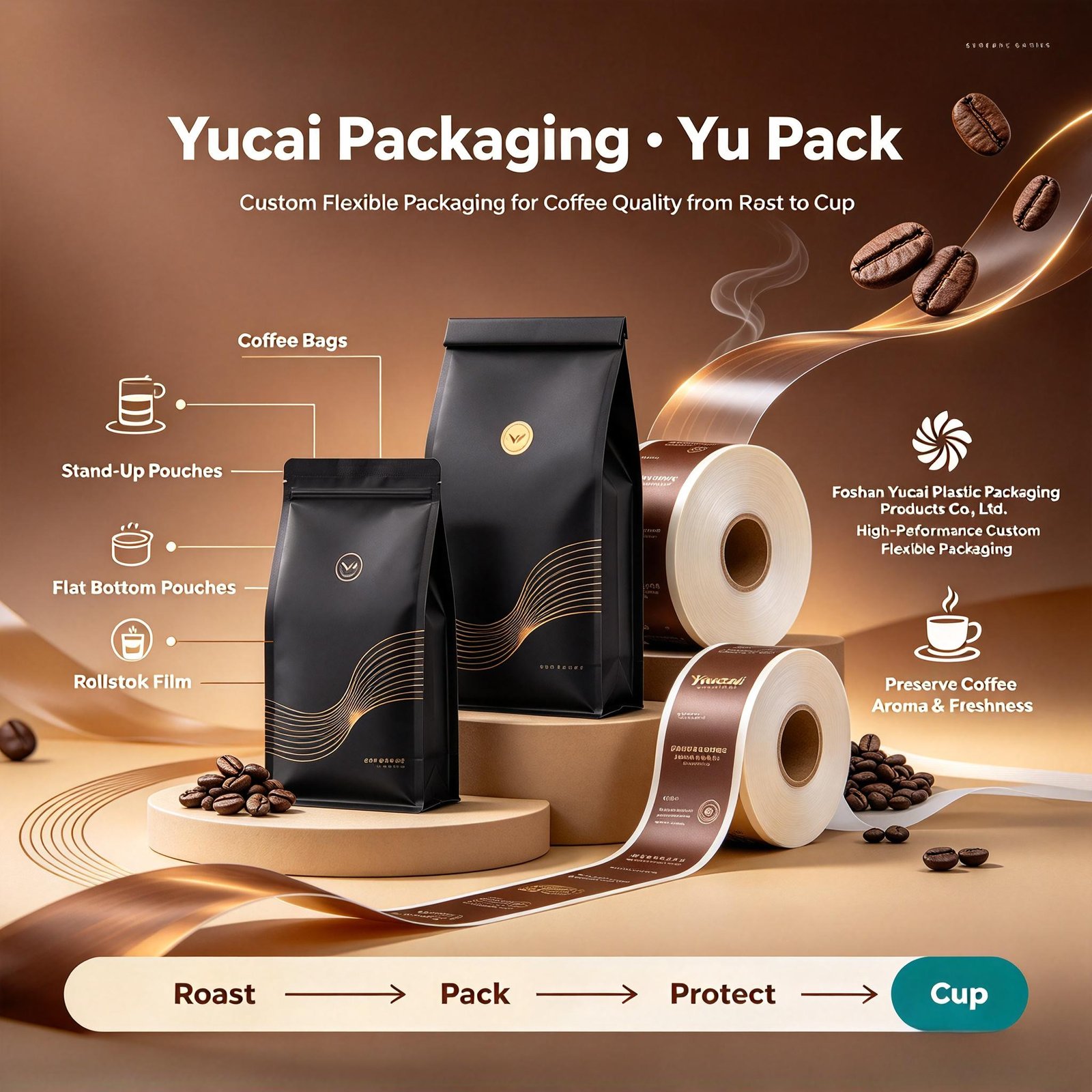
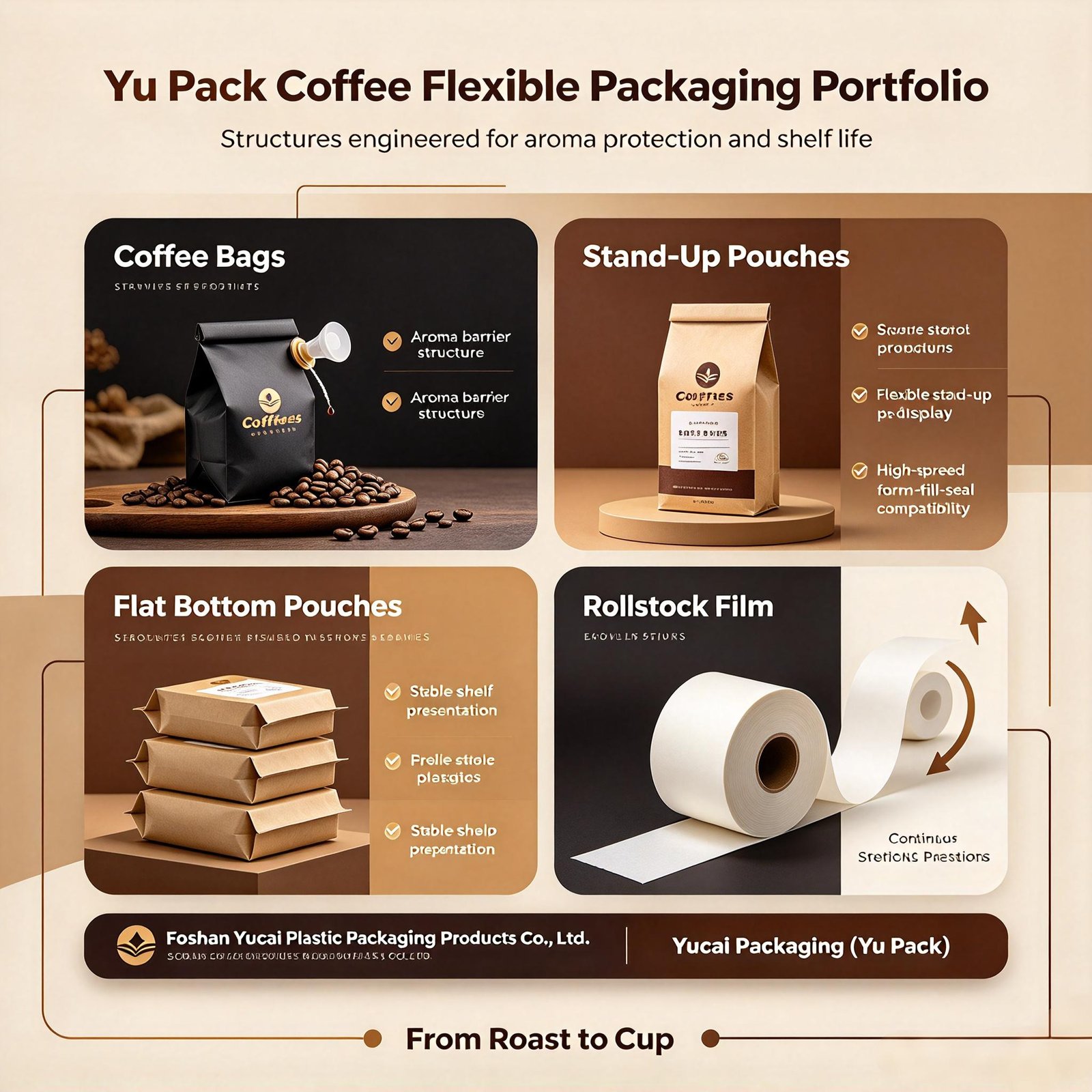
At Foshan Yucai Plastic Packaging Products Co., Ltd., operating under our primary brand Yucai Packaging (Yu Pack), we engineer high-performance custom flexible packaging—including specialized Coffee Bags, Stand-Up Pouches, Flat Bottom Pouches, and continuous Rollstock Film—designed to preserve coffee quality from roast to cup.
Here is an in-depth look at the key trends shaping coffee packaging in 2026 and how leading roasters choose better packaging solutions.
High-Barrier Recyclable Mono-Material Laminates
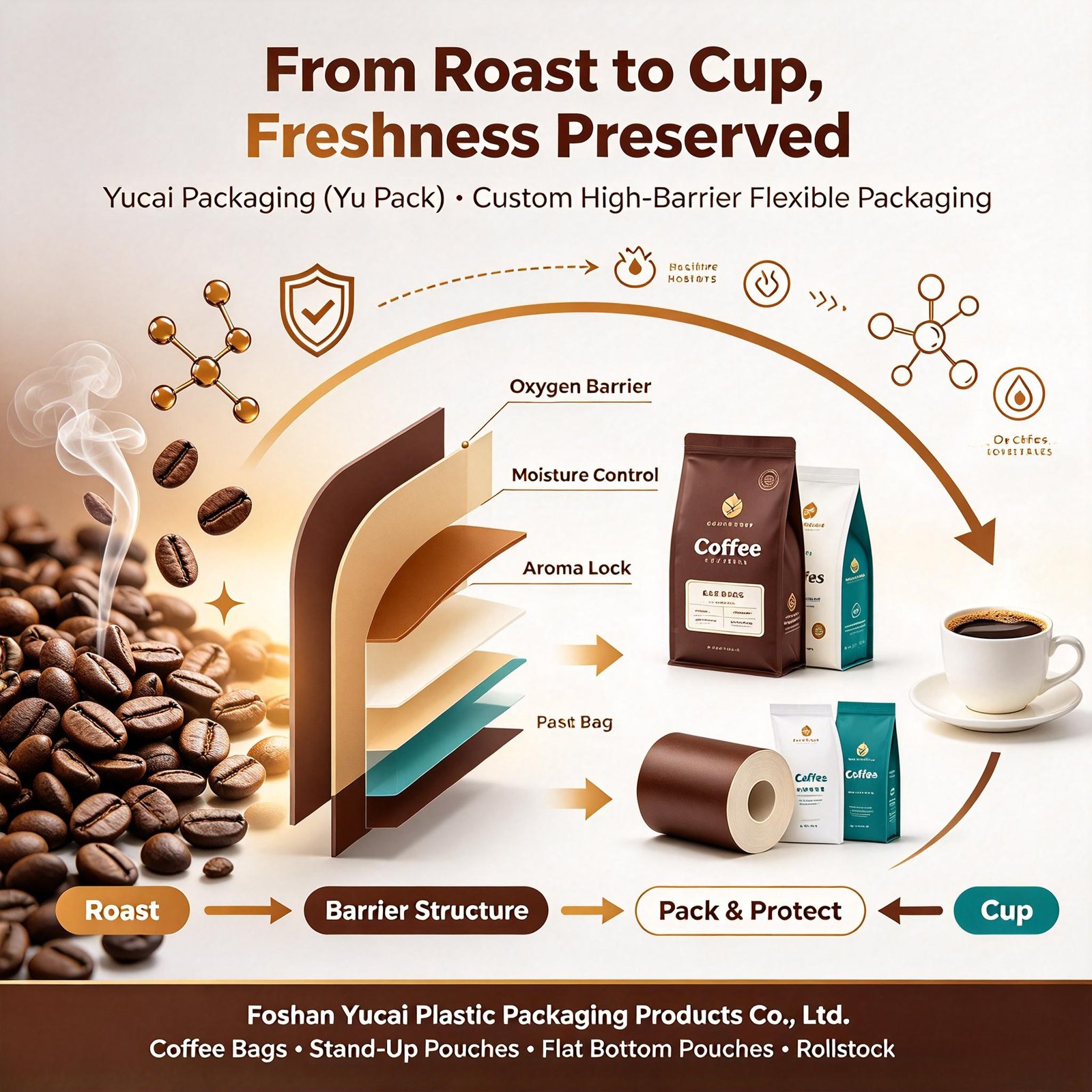
Freshly roasted coffee beans are highly sensitive to oxygen, moisture, UV light, and aroma loss. Historically, specialty coffee roasters relied on multi-material laminates containing aluminum foil (such as PET/AL/PE). However, these mixed-polymer structures cannot be processed in traditional municipal recycling streams.
Driven by global circular economy directives (such as EU PPWR and U.S. Extended Producer Responsibility laws), the coffee industry is rapidly adopting high-barrier, mono-material alternatives:
Mono-PE and Mono-PP Formulations: By leveraging advanced oriented polyethylene (MDO-PE) and polypropylene resins, Yucai Packaging (Yu Pack) manufactures 100% recyclable film structures that qualify for standard PE and PP store-drop-off recycling streams.
Foil-Free Ceramic Coatings: Microscopic vacuum-deposited silicon oxide (SiOx) or aluminum oxide (AlOx) coatings replace traditional metal foils. This maintains ultra-low oxygen transmission rates (OTR) and moisture vapor transmission rates (WVTR) to prevent oxidation, coffee oil rancidity, and flavor staling.
Solvent-Less Lamination: Utilizing two-component solvent-less adhesives during converting eliminates volatile organic compound (VOC) emissions, guaranteeing zero chemical solvent odor transfer to delicate coffee roasts.
Advanced Degassing Valves and Freshness Preservation
Freshly roasted coffee continually emits carbon dioxide (CO²) for days after roasting. Without proper degassing, sealed bags can bloat or burst; conversely, exposing coffee to ambient air causes rapid oxidation:
One-Way Degassing Valves: Integrating high-precision one-way degassing valves allows excess CO² gas to escape while preventing oxygen and moisture from entering the pouch.
Recyclable Valve Integration: To support mono-material packaging goals, modern valve designs are molded from PE or PP resins compatible with the main film body, allowing the entire coffee bag to be recycled together without removing components.
Hermetic Heat Seals: Utilizing metallocene inner sealant resins guarantees airtight, leak-proof perimeter seals that withstand thermal shock and mechanical vibration during international freight shipping.
Ergonomic Bag Formats and Premium Visual Aesthetics
Coffee packaging is a primary driver of brand identity and retail shelf placement. Brands select structural bag formats based on volume requirements and display presence:
Flat Bottom Pouches (Box Pouches): Featuring five distinct printable surfaces and a stable box-shaped base, flat bottom pouches maximize retail display presence and optimize pallet storage density.
Pocket Zippers and Reclosable Systems: Integrating press-to-close zippers, pull-tab zippers, or pocket zippers enables consumers to easily open and repeatedly reseal the package, protecting volatile coffee aromas throughout daily use.
Tactile Surface Finishes: Combining spot-UV glossy highlights with soft-touch matte backgrounds or kraft-paper textures creates tactile contrast that commands attention on retail shelves.
High-Speed Packaging Automation and Rollstock Runnability
Commercial coffee roasters and contract co-packers running high-volume operations rely on automated Vertical Form-Fill-Seal (VFFS) and Quad-Seal equipment fed by continuous Rollstock Film:
Controlled Coefficient of Friction (COF): Maintaining a strict kinetic COF (0.18 to 0.25) ensures smooth film movement over forming collars without slipping or web jamming.
Wide Thermal Sealing Windows: Advanced inner sealant layers enable sealing jaws to form instant, airtight bonds across broad temperature ranges (110ºC to 160ºC), even on high-speed lines handling 100+ fills per minute.
Nitrogen Flushing Compatibility: Rollstock materials engineered with high tensile strength prevent micro-fractures during inline nitrogen gas flushing, ensuring residual oxygen levels remain under 1%.
International Safety Compliance and Quality Assurance
Ensuring zero chemical migration and maintaining food safety standards are critical for global coffee distribution. Operating across a certified 15,000 m² manufacturing facility, Foshan Yucai Plastic Packaging Products Co., Ltd. produces flexible coffee packaging under certified ISO 9001, ISO 14001, and HACCP management systems.
All raw film substrates, degassing valves, printing inks, and inner food-contact sealant layers comply fully with global food safety standards, including the U.S. FDA Food Contact Packaging Regulations, guaranteeing zero chemical migration for global distribution.
Partner with Yucai Packaging (Yu Pack) for Coffee Solutions
Whether launching a specialty roast line in sustainable mono-material pouches or sourcing high-runnability rollstock film for automated packaging lines, Foshan Yucai Plastic Packaging Products Co., Ltd. provides material engineering expertise, custom valve integration, and direct-factory value.